
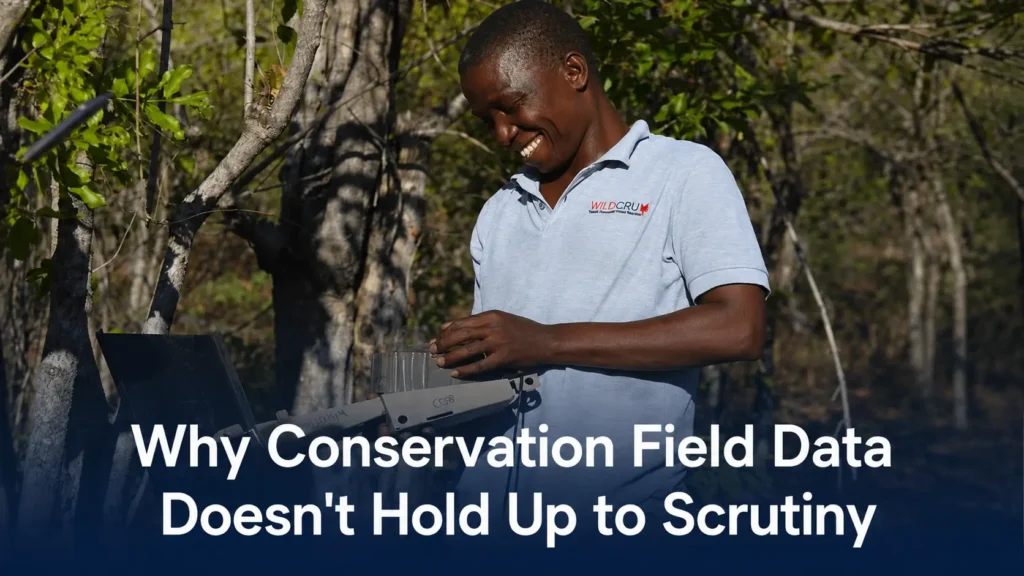
Conservation field data has a trust gap. Programs have gotten good at collecting species counts and patrol logs from places with no cell signal, but proving that a record wasn’t changed after it came back is a separate problem, and it’s mostly unsolved.
A ranger who logs a sighting on a tablet three hours from the nearest signal, or a patrol team that notes a snare removed with no connection at all, gets that data home intact. What happens to it afterward, whether it can still be trusted once a donor, an auditor, or a court needs to rely on it, is what this piece is about.
A field entry that can be opened and quietly edited months after it’s captured, with no visible trace of the change, doesn’t hold up under that kind of scrutiny. Offline capture solved getting the data home. Surviving the question of whether it was changed, however, is the part that’s still open.
That’s where VerusTrust Forms comes in.
Why Field Data Collection For Conservation Work Has a Trust Gap
Field data collection for conservation work has come a long way. Mobile apps capture GPS points, photos, and structured observations without a cell signal, then sync once a ranger is back in range.
That part of the problem is well covered ground at this point, including in our own look at offline data collection for wildlife conservation and offline field data collection for NGOs more broadly.
What’s covered far less is what happens to that record once it exists.
A species count sitting in a database or a spreadsheet can usually be opened and changed by anyone with access, and most systems don’t keep a visible history of what changed or when. For day-to-day field operations, that’s rarely an issue. The moment a record has to answer to someone outside the program, however, it quickly becomes a real problem.
After the data gets collected, the open question is whether it can be trusted. Both the question and the answer start with the conditions rangers actually work under.
What State of the Ranger 2024 Actually Found
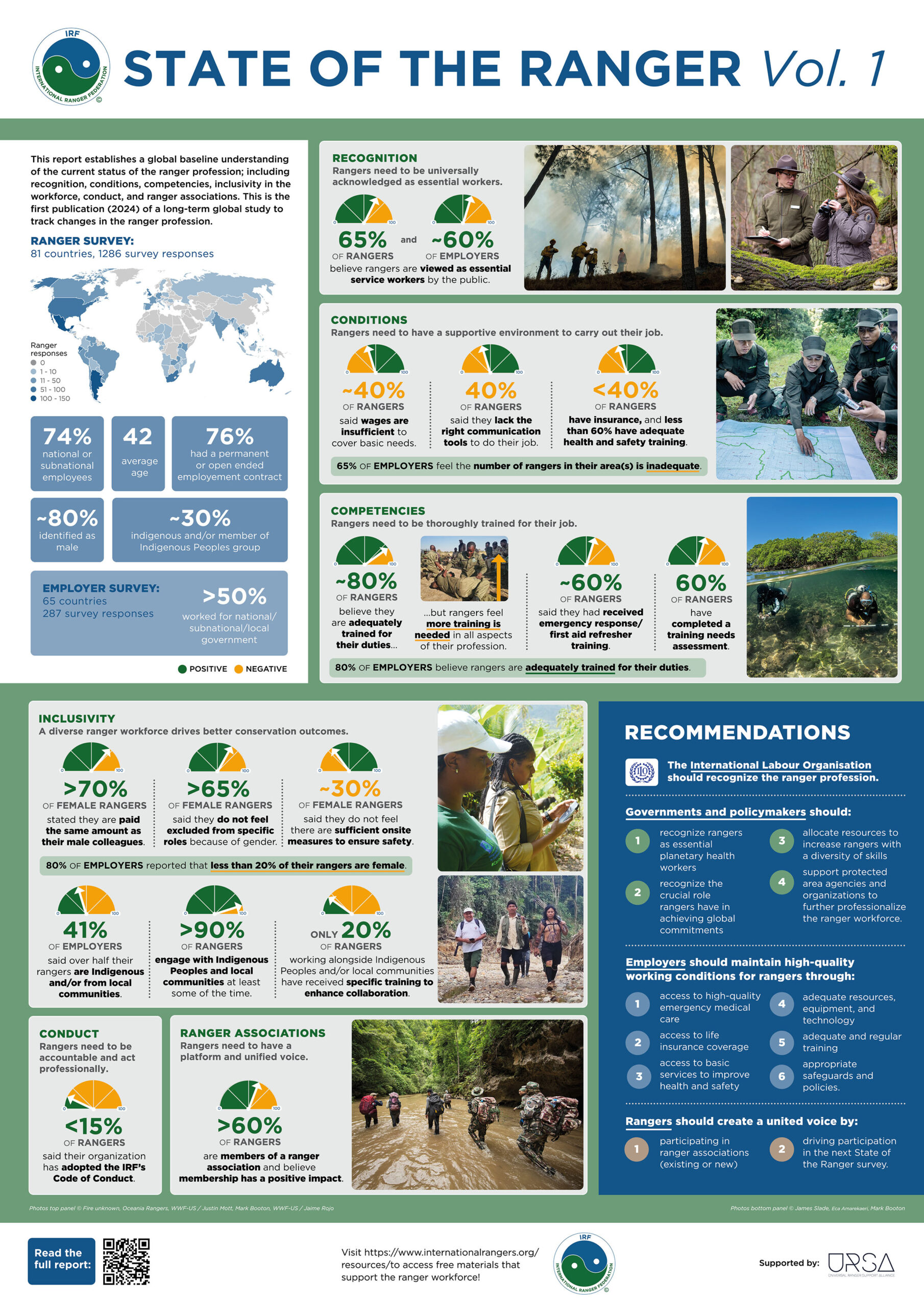
The International Ranger Federation and WWF published State of the Ranger, Vol. 1 in October 2024, the largest survey of its kind: 1,286 rangers and 287 employers, across 81 and 65 countries respectively, gathered over three survey waves. It’s the closest thing the sector has to a baseline on what ranger workforces actually have to work with.
The findings on equipment and technology are direct:
39% of rangers report not having adequate communication tools.
Where technology is available, it skews basic: 60% rely on cell phones, and only around 30% have access to computers or two-way radios.
Just over half, 51%, have reliable internet access at their workplace at all.
On the resourcing side, 47% of rangers say they have less than what they need to do the job, and 65% of employers agree ranger numbers themselves are inadequate for the areas they cover.
Training tells a similar story: 23% of rangers received zero training days in the past two years, and another 27% received less than a week.
These aren’t outlier programs. They’re the baseline conditions a lot of conservation field data gets collected under. A record made under those conditions still has to hold up to the same scrutiny as one made anywhere else.
Why Trafficking Cases Need More Than a Number in a Spreadsheet
Ranger conditions explain why field data collection is hard. What happens next explains why a record also has to be defensible.
The UNODC’s World Wildlife Crime Report 2024 documents illegal wildlife trade across 162 countries and territories between 2015 and 2021, affecting roughly 4,000 plant and animal species, about 3,250 of them CITES-listed. That’s the scale a species count, a patrol log, or a chain-of-custody record can end up feeding into. A ranger’s field note can become evidence, and evidence gets tested.
The report also flags a data and monitoring gap of its own: seizure data isn’t consistent enough, geographically or by species, to fully support enforcement decisions. Better records at the source, the kind a ranger actually creates in the field, are part of closing that gap. But a record only helps a prosecution or a funder audit if its history can be checked. A number in a spreadsheet, however accurate at the moment it was typed, doesn’t carry proof of that on its own.
The Real Question: Can This Record Prove It Wasn't Changed?
By this point, two things are already established: ranger conditions make data collection hard, and that data can end up mattering to a court or a donor. The question left is narrower.
Once a record exists, can anyone show it wasn’t changed after the fact?
“Tamper-evident” is a property of the record itself. The original value stays intact, and any later change to a verified field is detectable, whether or not anyone happens to be watching for it.
That’s a different guarantee than a password or a permissions setting offers. Those control who can open a system. They don’t leave a trace behind if someone with legitimate access opens a record and changes a number.
How VerusTrust Forms Makes Wildlife Conservation Data Verifiable
VerusTrust Forms is a no-code form builder built to close that gap. It doesn’t fix ranger staffing, training, or equipment budgets, and it won’t make a spreadsheet already in use tamper-evident retroactively.
What it does is give a program a way to make new field records tamper-evident from the point of capture, without adding a separate system for anyone to learn.
For a closer look at the mechanism itself, see Blockchain Traceability: How It Works, Benefits & Uses.
- Blockchain Verification & Smart Contracts: selected fields are hashed and anchored automatically on submission, with the proof held in a smart contract. Any later edit to a verified field is detectable, and the original value is preserved, included free on every plan.
- User Roles & Permissions: an auditor, donor, or prosecutor can get independently verifiable evidence without being handed direct access to the program’s own system, with permissions grouped by department, region, or project.
- Submissions Dashboard: every record carries a timestamped, user-attributed activity log, an audit trail that exists before blockchain verification is even layered on top of it.
- GPS Data Collection: point, line, and polygon fields geotag a record at the moment of capture, so location becomes part of the verifiable evidence instead of a claim someone has to take on faith
Fix the Trust Gap with Tamper-Evident Conservation Field Data
The fix for the trust gap took a specific mechanism to build, but it’s simple to state. Give every record proof it wasn’t changed, from the moment it’s captured, in a form a donor, an auditor, or a court can check without taking the program’s own system on faith.
Ranger budgets, training hours, and enforcement capacity are separate problems, and real ones. State of the Ranger 2024 and the UNODC report both describe them clearly.
This fix works alongside those problems. A record made under real field conditions has to survive contact with someone who wasn’t there when it was captured, whether that’s a grant auditor, a certification reviewer, or a court.
VerusTrust Forms is built around that fix. Start on the free plan, with blockchain verification included from day one, and see how it holds up against a real species survey or patrol log.
Frequently Asked Questions
What does "tamper-evident" mean for a conservation field record?
A tamper-evident record keeps its original value even after someone edits a verified field, and it shows that the edit happened. A password or a permissions setting only controls who can open the system. It doesn’t leave a trace if someone with legitimate access changes a number later.
Does offline data capture already solve this problem?
No. Offline capture solves a different, earlier problem. It gets reliable data out of a location with no cell signal. It doesn’t address what happens to that record after it syncs, or whether someone downstream can verify it wasn’t changed. A program can need offline capture, verifiability, or both, depending on where its data ends up being used.
Is blockchain verification included on every VerusTrust Forms plan?
Yes. Blockchain verification is included on every VerusTrust Forms plan, including the free-forever one, with no credit card required to start.
Start for free and anchor a real species survey or patrol log to see what a verifiable record looks like end to end.